
Simone Nota
IT

Postdoctoral Fellow · Institute of Philosophy, Zagreb

Thinking at the edge of metaphysics and transcendental philosophy

My work brings a transcendental perspective to problems about the nature of reality, knowledge, language and mind, reading Kant and Wittgenstein against contemporary debates.

  • Metaphysics
  • Epistemology
  • Philosophy of language
  • Philosophy of mind
  • Kant
  • Wittgenstein
Portrait of Simone Nota

Research

My guiding question is: What are the conditions that make representation of reality possible? I answer through three connected lines of work.

Main line

Transcendentalism

I study transcendental philosophy, any outlook aimed at recognizing the necessary conditions for the possibility of our cognition. My interest began with the problem of the possibility of metaphysics, traditionally a systematic inquiry aimed at at a priori knowledge of the nature of reality.

Through the critical lenses of Kant and Wittgenstein, I distinguish transcendentalism as a methodological stance from transcendental idealism as a metaphysical doctrine that makes the form of empirical reality depend on our human point of view. Studying the conditions of our cognition can give us self-knowledge without a metaphysical doctrine: an understanding of metaphysics is not necessarily a metaphysical understanding.

Read my PhD dissertation (PDF)


Recent interest

Absolutism

Recently, I have turned to absolute philosophies, metaphysical views that aim at a conception of reality as it is from no particular perspective. I focus on contemporary forms: absolute realism, where reality can be known independently of any subjective perspective, and absolute idealism, where self-knowledge is the whole of reality.

I argue that absolute philosophies are incoherent and that we should return to perspectival ones, such as transcendental philosophy. The absolute conception may still keep a role as a regulative ideal.

Long-term project

Naturalism

Lastly, I am interested in philosophies that give methodological priority to nature and to our a posteriori knowledge of it. I look at two variants: scientific naturalism, which takes nature to be what science tells us there is, and humanistic naturalism, which takes human nature and its socio-cultural expressions to be irreducible to science.

A bridge: the relativized a priori

My long-term aim is to connect transcendentalism and naturalism through an a priori that holds only relative to certain scientific paradigms or human communities. Doing this calls for a transcendental philosophy of science and a transcendental anthropology.

I have also worked on linguistic falsehood, dreaming and skepticism, theories of intentionality, and thought experiments. See the publications below.

Publications

Peer-reviewed articles, with full texts available as PDF.

Philosophical Investigations · 2026

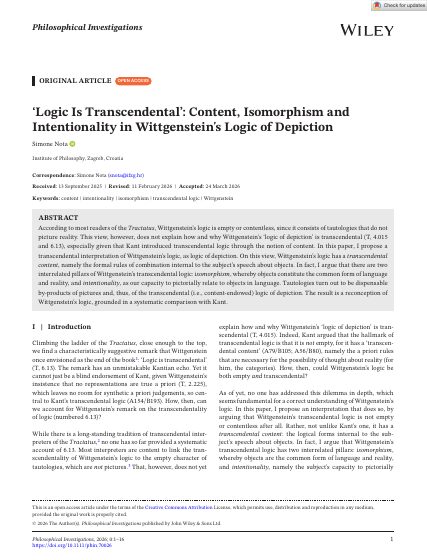
“Logic Is Transcendental”: Content, Isomorphism and Intentionality in Wittgenstein’s Logic of Depiction

Most readers take logic in the Tractatus to be empty, since tautologies do not picture reality, yet this fails to explain its transcendental status. I propose a transcendental reading of the logic of depiction: its content is the formal rules governing the subject’s speech about objects.

Teorema · 2024Teorema Essay Prize 2024

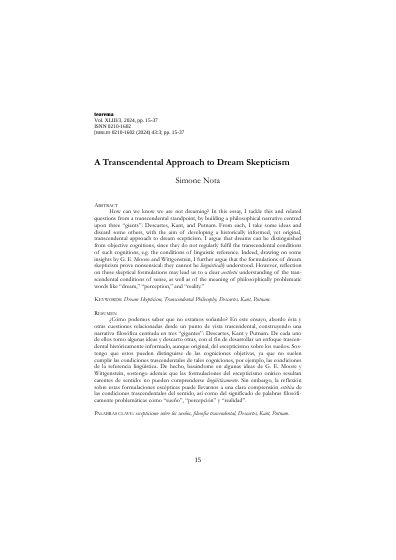
A Transcendental Approach to Dream Skepticism

How can we know we are not dreaming? I take up this question from a transcendental standpoint, building a narrative around three giants: Descartes, Kant and Putnam. I keep some of their ideas and drop others, to develop an approach that is historically informed and original.

Phenomenology and Mind · 2022

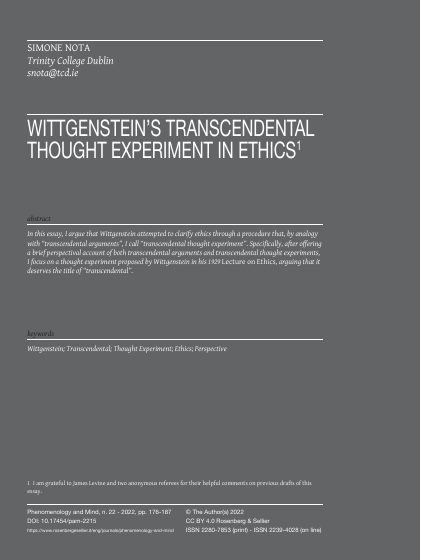
Wittgenstein’s Transcendental Thought Experiment in Ethics

Thought experiments are narratives that lead us to visualize a possible scenario and, when properly run in thought, to certain conclusions. Transcendental ones can lead us to the necessary conditions of representing reality. I argue that in the “Lecture on Ethics” Wittgenstein used one to clarify ethics.

Synthesis · 2021

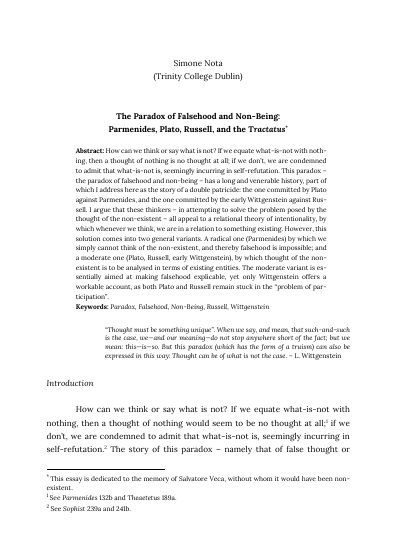
The Paradox of Falsehood and Non-Being

How can we think or say what is not? If what-is-not is nothing, a thought of nothing seems to be no thought at all; if it is not, we must admit that what-is-not is, and refute ourselves. I address the paradox through Parmenides, Plato, Russell and the early Wittgenstein.

Teaching

Alongside my research, I have taught undergraduate classes for philosophy and science students at Trinity College Dublin as a teaching assistant.

  • Early modern philosophy
  • Kantian and post-Kantian philosophy
  • Analytic philosophy
  • Metaphysics
  • Philosophy of science
  • Ethics of science
  • Philosophy of mind

Students at the centre

The aim is to draw students into genuine philosophical puzzles, helping them to reflect independently.

Open questions

The work of reasoning matters as much as the conclusion reached.

Conceptual tools

I provide students with conceptual tools they can use and sharpen in their own lives.

A creative close

Every class ends with a creative group activity to train understanding, imagination and empathy.

These skills matter not only for a successful academic life but also for a more fulfilling human one.

AI & Philosophy

Philosophical ideas, from Hegel’s owl to Wittgenstein’s ladder, turned into pictures with AI.

Open the gallery